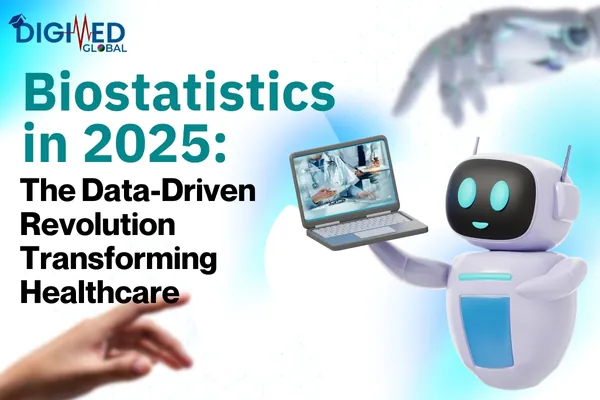
In 2025, biostatistics is undergoing a massive transformation driven by AI, big data analytics, and precision medicine. Biostatisticians have evolved from number crunchers to strategic healthcare innovators who use data to make decisions that save lives and improve treatments as healthcare generates more data than ever before.
The Current State of Biostatistics: A Field That Is Growing Fast
Biostatistics is becoming one of the fastest-growing fields in healthcare and data science. Since 2004, the number of jobs available for biostatisticians has increased by 128.13% across the country, making it one of the fastest-growing fields in statistics.[1]
Revolutionary Applications Changing Healthcare in 2025
Genomics and Precision Medicine
Biostatistics is leading the precision medicine revolution, which aims to make treatments more effective by considering a person's genes, environment, and lifestyle.
The global precision medicine market is expected to grow at 12.1% annually, reaching $254 billion by 2032.[3]
More than 30% of breast cancer cases can now be analyzed using targeted therapy, with biostatistical models helping reduce recurrence rates by up to 52% through personalized treatment selection.[4][3]
AI and Machine Learning Integration
The combination of artificial intelligence and traditional biostatistics is a major step forward in healthcare research.[5]
Modern biostatisticians use AI for pattern recognition, predictive modeling, and automated clinical study reports.[6]
AI and machine learning are revolutionizing biostatistics by automating routine work, improving model accuracy, and enabling real-time, patient-centered insights.[5][6]
Wearable Technology and Digital Health
The rise of wearable health technology has opened new areas for biostatistical analysis.
Wearables with AI are changing from passive observers to active health partners, sending constant streams of biometric data.[7]
AI-powered wearables generate continuous streams of biometric data that biostatisticians use to monitor population-level health trends, personalize treatment plans, and identify early warning signs of disease progression.[7][8]
Clinical Trial Optimization
Biostatistics remains crucial for designing and analyzing clinical trials, ensuring they are fair, effective, and statistically powerful.[9]
In 2025, biostatisticians are increasingly using adaptive designs, Bayesian methods (with FDA draft guidance expected by end of FY 2025), and real-world evidence.[10][11]
Career and Educational Paths
Educational Requirements
A master's degree is typically the minimum education needed to work as a biostatistician. The usual educational path includes:[12][2]
- A bachelor's degree in a quantitative field (statistics, mathematics, biology, etc.)
- A master's degree in biostatistics, public health, statistics, or epidemiology
- A PhD for academic or leadership roles (optional but beneficial)
Educational programs now emphasize programming proficiency in multiple environments, including R, STATA, SAS, SPSS, Python, and EPI Info, reflecting the field's increasingly technical nature.[13]
Skills Needed for 2025
Modern biostatisticians need expertise in:
Career Progression and Salary
The job market for biostatisticians remains strong, with over 1,000 positions currently open in India.[17]
Cost reduction is a primary driver for 64% of companies implementing AI in biostatistics, suggesting strong job security as organizations seek efficiency improvements rather than workforce reduction.[18]
Technology Stack: Essential Tools for Biostatisticians
Programming Languages & Software
Emerging Technologies
- Jupyter Notebooks for interactive computing and reproducible research
- Cloud-based tools for big data analysis
- AI-assisted tools for automated statistical analysis and reporting
FDA and Regulatory Changes
The FDA's Office of Biostatistics continues to be a key player in encouraging science-based, innovative, and quantitative decision-making at every stage of drug development.[11]
Important Regulatory Changes in 2025
Challenges and Future Outlook
Data Privacy and Ethics
As biostatistics increasingly relies on sensitive health data, professionals must navigate complex data privacy issues, algorithmic bias, and ethical considerations. The integration of AI amplifies these concerns, requiring robust validation methods and transparent reporting practices.[16]
Skills Gap and Education
The rapid evolution of biostatistics has created a pressing need to integrate biostatistics education at undergraduate and postgraduate levels. Educational institutions must address the gaps in statistical literacy among healthcare professionals and ensure curricula keep pace with technological advances.[8]
Global Collaboration and Standardization
International collaboration is essential for advancing biostatistical methods and ensuring standardized protocols across different healthcare systems and regulatory environments.[16]
Conclusion: Healthcare's Future is Data-Driven
In 2025, biostatistics represents the convergence of traditional statistical rigor, cutting-edge technology, and innovative healthcare delivery. As the field evolves, biostatisticians are becoming increasingly important in transforming healthcare from reactive treatment to predictive, personalized, and preventive care.
For those passionate about using data to improve human health, this field offers exceptional career prospects. With healthcare data growing by 36% annually and precision medicine becoming more prevalent, biostatisticians are poised to become some of the most important professionals in modern healthcare.[1]
Ready to Join the Data Revolution in Healthcare?
The message is clear for aspiring biostatisticians: embrace continuous learning, master both traditional statistical methods and emerging AI technologies, and prepare to be at the forefront of healthcare's data-driven transformation.
Explore Biostatistics CourseReferences
- Warman O'Brien: 5 Reasons Why Biostatisticians Will Be a Crucial Hire in 2025
- Coursera: Biostatistician Career Guide
- Market.us: Precision Medicine Statistics
- LLRI: Applications of Biostatistics in Healthcare Epidemiology
- PubMed: AI and Machine Learning in Biostatistics
- Akkodis: AI, ML, Big Data in Biostatistics
- ISHIR: AI and Wearable Health Tech
- Saudi Journal of Medicine: Biostatistics in Modern Healthcare
- JHSR: The Evolving Role of Biostatistics in Medical Research
- Bayes Pharma: Bayesian Methodology in Clinical Trials
- FDA: Office of Biostatistics
- Indeed: How to Become a Biostatistician
- Manipal University: MSc Biostatistics
- Data Science School: Data Science Tools List
- JAMA: FDA Regulatory Changes 2025
- Informatics Magazine: Latest Trends in Biostatistics Research
- LinkedIn: Biostatistician Jobs in India
- LinkedIn: AI in Biostatistics and Clinical Analytics 2025